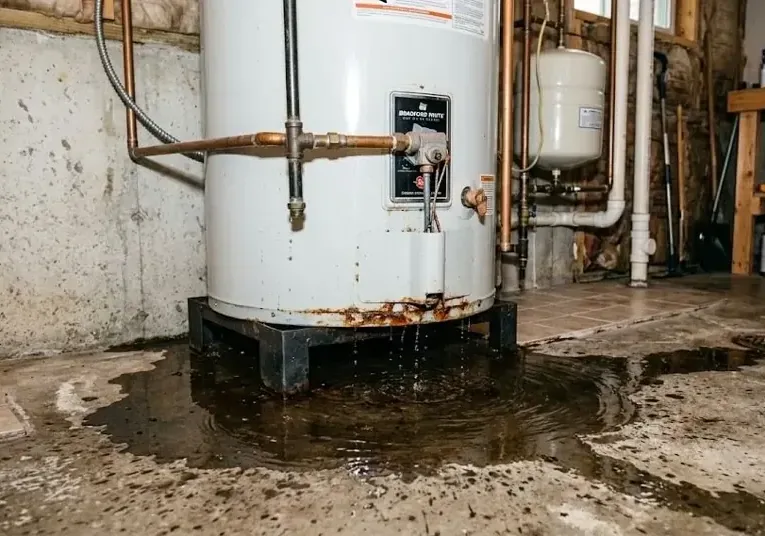
A tank water heater holds enough water to flood a closet or garage floor quickly. The leak may begin as a damp patch and grow into a spreading puddle that reaches walls, cabinets and stored boxes.
Key takeaways
- Shut off the cold water supply to the tank and turn off power or gas at the unit.
- A leaking tank is a replacement job, so cleanup and the plumber are two separate steps.
- Garage tanks spread water across the slab, while closet tanks send it into wall framing and floors.
- Baldwin Stocker has many single-family homes built from the late 1940s through the early 1970s on lots of about 7,300 to 7,500 square feet.
- Stored cardboard, paper and fabric wick water up fast and should be moved first.
How a tank fails
Tanks rarely fail all at once. A seam weeps, a fitting loosens or the bottom of the tank corrodes, and the drip becomes a flow.
By the time water reaches the floor drain, wall or door, the tank may have already released a lot of its volume.
Because a tank is usually tucked in a closet, a garage corner or a utility room, a leak can run unnoticed for a while.
- A puddle or damp spot beneath the tank.
- Rust streaks on the tank or its connections.
- A hissing, dripping or rumbling sound.
- Rusty or cloudy hot water.
- A warped or stained floor near the closet door.
Arcadia homes and where the heater sits
Arcadia is a San Gabriel Valley city at the base of the San Gabriel Mountains. In 2010, the census counted 20,686 housing units, with about 63.1 percent of occupied units owner-occupied and 36.9 percent rented.
In Baldwin Stocker, many single-family homes were built from the late 1940s through the early 1970s, often on lots of about 7,300 to 7,500 square feet. Garages and hall closets are common places for a tank in homes of that era.
The City of Arcadia provides water and sewer service to residents, but the tank and the plumbing around it are inside the property, so the repair belongs to the owner.
What to do in the first minutes
Stopping the flow comes first, then protecting the structure.
- Close the cold water shutoff valve on top of the tank.
- Turn off the electric breaker or set the gas control to off.
- Do not touch the tank or outlets while standing in water.
- Move boxes, tools and electronics out of the wet area.
- Take photos and call a plumber and a water damage team.
Where the water goes
The location of the tank decides the damage pattern.
Garage tanks
Water spreads across a concrete slab and heads toward the lowest point. It may reach a door threshold, a floor drain or a stored pile of boxes.
Cardboard and paper wick water and collapse, so they are removed first. The slab is then washed and dried.
Closet tanks
A closet is small, and the water has little room to spread across the floor. Instead it soaks the bottom of the walls, the baseboards and the flooring that runs into the hallway.
The drying team often opens the lower wall to check the framing and insulation.
Signs of a slow leak versus a failure
A slow leak and a sudden failure call for the same first steps, but the cleanup differs in scope.
A slow leak may have soaked the floor beneath the tank for weeks. The visible puddle is only part of it, and the flooring, wall base and slab may be wet underneath.
A sudden failure releases a large volume in a short time. The water reaches farther, but it is also easier to see and to extract.
What a slow leak leaves behind
Rust rings on the floor, warped baseboards and a musty smell are typical.
Stored items kept on the floor near the tank often show staining at the bottom edge.
What a sudden failure leaves behind
Water is pooled across the whole floor and may run under a door or into a hall.
Items on the floor are soaked through, and nearby drywall may wick water several inches high.
Garage storage and what to move
Many Arcadia homes use the garage for storage as well as the water heater. That makes the first minutes a sorting job.
Move the items that wick water or cannot be replaced, and leave heavy furniture for the crew.
- Cardboard boxes and papers, which wick water and fall apart.
- Photo albums, documents and keepsakes, which can be dried or frozen by a specialist if moved quickly.
- Fabric items such as holiday decor, bedding and clothes.
- Electronics and tools with motors.
- Anything stored against the wall behind the tank.
When drywall needs to be opened
Drywall can absorb water several inches up from the floor. If it stays wet, it can soften, stain and grow mold.
The drying team uses a moisture meter and, where needed, a small inspection cut to look into the wall cavity.
A common approach is a flood cut, which removes the bottom band of drywall so air can reach the cavity. The cut is made above the highest wet reading so the remaining wall stays dry.
How the cleanup works
Local water damage experts use truck mounted or portable units to extract standing water, then remove wet baseboards and any drywall that has soaked through.
Hot water leaks are clean at first, but they soak into dust and finishes quickly. The team treats the area promptly so odors and stains do not develop.
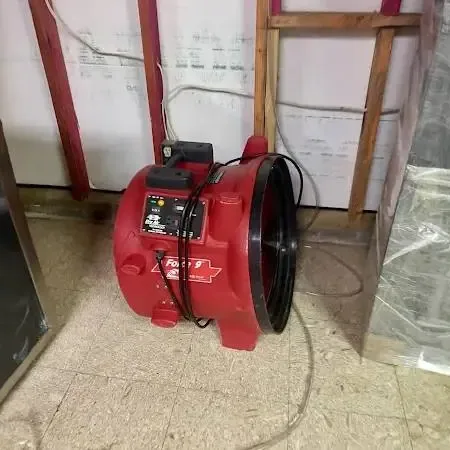
Moisture readings are taken before, during and after drying to confirm the structure is dry.
- Extraction of standing water.
- Removal of wet baseboards, insulation and pad.
- Air movers and dehumidifiers placed and logged.
- Moisture readings repeated until normal.
- Cleaning and deodorizing of the area.
Replacing the tank and preventing a repeat
The failed tank is replaced by a plumber, and a drain pan with a drain can reduce the risk of damage from a small leak. Rules for permits vary and are not described here.
Homeowners can check the tank each season for rust, damp spots and corrosion on fittings. An older tank that shows signs of wear is worth replacing before it fails.
Local services are collected on the Arcadia hub, with water heater leak cleanup and water extraction covering this kind of loss. The wider overview is under water heater leaks.
Insurance and records
Photos before cleanup, a note of when the leak was found and receipts for the plumber and the cleanup help later conversations.
Keep the old tank until the claim is settled if possible, since the failure point may matter.
Questions
Should the hot water heater be turned off after a leak?
Yes. Close the cold supply and turn off power or gas at the unit before anything else.
Can a leaking tank be repaired?
A leaking tank is generally replaced. A plumber handles that while the water damage team handles the wet structure.
What gets wet first in a garage?
Stored cardboard, paper and fabric wick water quickly, and the concrete slab spreads it toward doors and drains.
Does a closet leak reach the walls?
Yes. The water soaks baseboards and the lower wall, so the drying team opens the wall and checks the framing.
How is the area confirmed dry?
Moisture readings are compared to a dry reference and equipment stays until the area matches it.