About Temple City Water Damage Restoration
24/7 water damage restoration for Temple City, CA and the west San Gabriel Valley, from the first extraction pass to the last moisture reading.
(888) 578-6508 Ask how a dry-out gets planned Find us on GoogleRestoration shaped by how valley houses take on water
Temple City began as the Town of Temple in 1923 and stayed small until the housing boom after World War II, which led to incorporation in 1960. Many homes in the area are single-family houses on concrete slabs or raised floors, often with garage water heaters, and homes with older plumbing can have supply lines that wear thin over time.
Common jobs include pinhole leaks under slabs, supply failures inside walls, sewer laterals that back up into the lowest drain, and winter storms that overwhelm a blocked storm drain. The restoration team extracts the standing water, maps what is still wet behind walls and under floors, and dries the structure to the IICRC S500 standard.
Water and sewage only: water extraction, slab leaks, sewage backups, pipe leaks, storm water, roof and ceiling leaks, water heater and appliance leaks, crawl space water, structural drying and commercial losses.
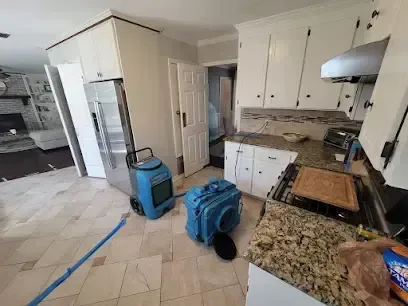
How each dry-out is held to a standard
- 01
Map the moisture
Thermal imaging and pinless meters find wet drywall, framing and slab before a single fan is set.
- 02
Pull the water
Truck-mounted extraction removes standing water so it leaves the house instead of soaking the next room.
- 03
Set the drying system
Air movers sized to each room push evaporation and LGR dehumidifiers pull that moisture out of the air.
- 04
Prove it is dry
Readings are logged daily, and equipment comes out once materials sit within 2 to 4 points of a dry reference.
- IICRC S500 drying standard
- Category 1, 2 and 3 protocols
- Class 1 to 4 equipment sizing
- EPA-registered antimicrobial
Three things a finished dry-out always has
Readings, not guesses
Moisture mapping before equipment goes down, then daily readings until wet materials sit within 2 to 4 points of a dry reference.
The category sets the plan
Clean, gray and black water get different treatment. Porous materials touched by Category 3 water are removed, not dried.
A record from day one
Timestamped photos before demolition, a moisture map and daily psychrometric logs give the insurer a clear file.
Water where it should not be? The restoration team is ready.
Extraction, drying and documentation around the clock, across the west San Gabriel Valley.