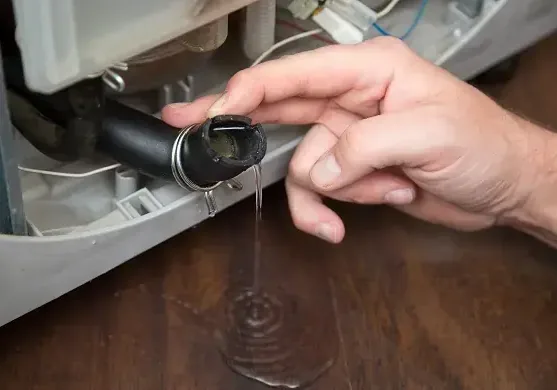
The hoses behind a washing machine sit under constant pressure. When one splits or slips off, water can fill a laundry room quickly and travel into hallways, bedrooms and neighboring walls.
Key takeaways
- Closing the two shutoff valves behind the washer stops the flow at the source.
- Temple City counted 12,216 housing units and 62.4 percent owner-occupied at the 2020 census, so rentals are part of the picture.
- A tenant should tell the landlord in writing and keep photos.
- Laundry leaks soak baseboards, cabinet bases and the subfloor under vinyl or laminate.
- Drying is confirmed by moisture readings, not by how a floor looks.
Why washer hoses fail
Washer hoses carry water at full household pressure. A bulge, a crack or a loose coupling can turn into a full spray when the machine fills.
The leak can happen while the machine runs or while it is idle, since the hoses remain under pressure all the time.
- Bulges or cracks in the hose.
- Rust or mineral crust on the couplings.
- A hose that rubs against the wall or a tight bend.
- Water on the floor behind the machine.
- A damp smell near the laundry area.
Homes and rentals in Temple City
Temple City had 36,494 residents and 12,216 housing units at the 2020 census, and 62.4 percent of occupied units were owner-occupied.
The city grew after World War II and was incorporated on May 25, 1960, so many laundry rooms are inside homes of different ages.
In a rental, a leak can raise questions about who pays and who is notified. A quick written note to the landlord, with photos, protects the tenant.
The first minutes
Stopping the water is the priority.
- Close both shutoff valves behind the washer.
- If they are stuck, close the main water valve.
- Unplug the washer from a dry spot, or turn off the breaker.
- Move rugs, baskets and cleaning supplies out of the water.
- Photograph the room and the hoses before any repair.
Where the water ends up
Laundry rooms are often small and on the same floor as bedrooms and hallways. The floor slopes toward the nearest low point, and the wall base soaks.
Water can pass under a door, travel under flooring and reach carpet in the next room.
Floors
Vinyl and laminate trap water below the surface. A floor that looks fine can have a wet subfloor below.
The drying team uses a moisture meter and may lift a few boards or a corner of the vinyl.
Walls and cabinets
Baseboards, the bottom of the drywall and cabinet toe kicks wick water up. They are removed or opened so air can reach the cavity.
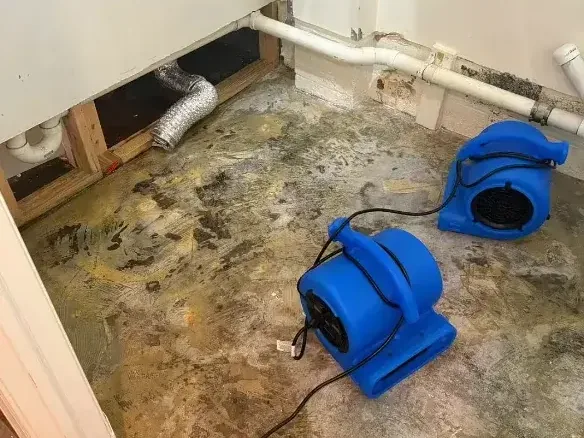
A leak behind the machine versus a leak inside the wall
Not every laundry leak is a hose. A supply valve can drip, a drain pipe can overflow or a connection in the wall can fail.
The leak source decides the repair, but the drying steps are almost the same. Find the wet area first, then trace back.
- A hose leak shows water behind the machine and at the couplings.
- A valve leak drips at the wall box.
- A drain overflow shows water at the standpipe during a spin cycle.
- A wall leak leaves a stain on the adjacent room.
- A hidden leak raises the water bill.
How far the water travels
A laundry leak looks small, but a washer hose can release a large volume while it runs. Once it reaches the floor, the water follows slopes and seams.
In a house, the path often runs to a hallway, a closet or a bathroom. In a multi-unit building, it can reach a neighbor's ceiling.
In a single-family home
The water spreads across the floor and soaks the base of the walls. If the laundry room backs onto a garage, water may flow under the door.
Carpet in a nearby room can wick water from the edge.
In a rental or shared wall
A tenant should tell the landlord and, if a neighbor's wall is wet, let the manager know too.
Early notice limits damage and avoids disputes.
What to keep for a claim
Photos of the hose, the water and the damaged areas help. A short note of the time, the actions taken and the people told is valuable.
Keep the failed hose in a bag, since its condition can matter.
- Photos of the floor and the walls.
- The failed hose or fitting.
- Receipts for emergency work and repairs.
- Messages to the landlord or manager.
- The drying team's moisture log.
Floor types and how they dry
Different floors respond differently to a laundry leak. The drying team picks the method for each.
Tile dries fast on the surface, but the grout and the bed below can hold water. Laminate swells at the edges.
Vinyl traps moisture beneath.
What a good drying log looks like
The log lists each room, the readings on day one and the readings on each visit. The numbers should go down toward the dry reference.
If a reading stops falling, the team checks for another wet source or moves equipment. A log that shows steady drop is the best proof that the structure is dry.
Extraction and drying steps
The extraction crew removes standing water with portable units, then the drying team sets up air movers and dehumidifiers.
Readings are taken at the start and again at each visit. The goal is a match with a dry reference reading from an unaffected part of the home.
If drywall or insulation stays wet for a day or two, mold can start, so the team opens wet cavities early.
- Standing water extracted.
- Baseboards and toe kicks removed.
- Subfloor and framing dried.
- Equipment logged and monitored.
- Final moisture reading before removal.
Preventing the next leak
Washer hoses wear out. Replacing old rubber hoses with braided ones and checking them twice a year helps.
Leaving the shutoff valves closed when away for long periods is another habit.
A water alarm on the floor behind the machine gives early warning.
Related local pages include appliance and supply hose leaks and structural drying. The water damage cost calculator can help with planning, and water extraction covers the first step.
Questions
How can a washer leak be stopped quickly?
Close both shutoff valves behind the machine. If they are stuck, close the main water valve.
Who should a renter tell?
The landlord or manager, in writing, with photos. Keep every message.
Can water get under the flooring?
Yes. Vinyl and laminate hide water, so moisture readings are taken before anything is covered.
How often should hoses be replaced?
Check them twice a year and replace any that bulge, crack or show rust at the coupling.
Is mold a risk after a laundry leak?
It can be if wet materials stay damp for a day or two, which is why fast drying matters.