Rain finds the weak spot in a roof, and the weak spot is often hard to see from the ground. In an older single story house, the first sign is usually a stain on a bedroom or hallway ceiling.
Key takeaways
- Half of Pico Rivera's housing stock was built in the nine years from 1950 to 1959.
- The city's housing plan says housing over 30 years old typically needs major work such as a new roof, foundation or plumbing.
- A leak shows up first in the ceiling but often starts in the attic or at flashing and vents.
- Temporary protection comes first, then drying the insulation, the drywall and the framing.
- Drying before repair keeps wet material from sitting behind a fresh ceiling.
A city of single story houses
Pico Rivera is a city of 62,088 residents at the 2020 census. Over 75 percent of its housing units are single-family detached homes.
Half of the housing stock was built from 1950 to 1959, and only 2.5 percent has been added after 2000.
The city's housing plan notes that housing over 30 years old typically needs major rehabilitation such as a new roof, foundation or plumbing. That makes roofs a common source of storm leaks in older neighborhoods.
Where storm water gets in
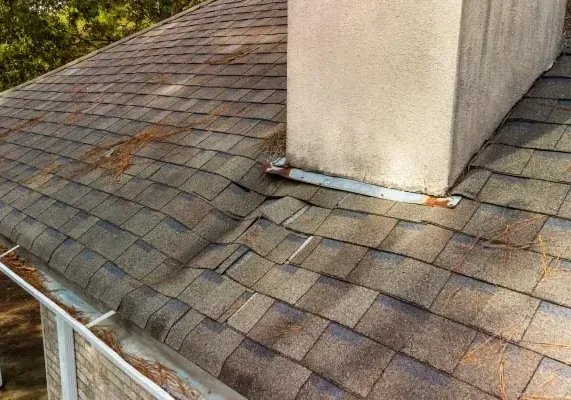
Water rarely comes through the field of a roof. It comes through the places where the roof is cut or joined.
- Flashing around chimneys, vents and skylights.
- Valleys where two roof planes meet.
- Nail heads and exposed fasteners.
- Worn shingles near edges and ridges.
- Gutters that overflow back under the roof edge.
How the water travels after it gets in
A leak can enter at one point and show up at another. Water runs along rafters, drips onto insulation and spreads before it reaches the ceiling drywall.
By the time a stain appears, the insulation above it has often been wet for a while.
What the attic shows
A flashlight look at the attic often shows dark rafters, compressed insulation or damp decking near the entry point.
The restoration team checks these with a moisture meter, since wood can look dry and still be wet inside.
What the room shows
Inside, early signs are a faint ring, peeling paint or a bubble in the ceiling texture.
Later signs are sagging drywall, a musty smell and drips during a downpour.
Signs of a roof problem before the first leak
Roof trouble often gives hints before a ceiling stains. Homeowners can look from the ground or from a ladder at the edge, never by walking on a wet roof.
- Shingles that are curled, cracked or missing after wind.
- Granules collecting in gutters.
- Daylight visible in the attic through the roof deck.
- Rust or loose flashing around vents.
- Water marks on the underside of the roof deck.
Tracing a leak that is not obvious
Finding a roof leak is often detective work. The stain on the ceiling points to an area, not to the exact spot.
A common approach is to trace uphill. The water enters higher than the stain and follows framing downhill.
A roofer may use water tests, one section at a time, to confirm the entry point without guessing.
- Start at the stain and look uphill in the attic.
- Follow dark streaks on the rafters.
- Check the nearest penetration, such as a vent or pipe.
- Look for a lifted or cracked flashing seam.
- Confirm with a controlled water test.
Insurance and records for a roof leak
A roof leak claim often turns on the cause. Sudden storm damage is handled differently than long wear, so records matter.
Photos from the first day, the roofer's note and the drying log together tell a clear story.
The role of the attic
An attic is a cold, dark room that traps wet insulation. Wet insulation flattens, loses its value and holds water against the ceiling drywall.
The restoration team checks the attic with a flashlight and a moisture meter. Wood that reads wet is dried in place if it can be, and removed if it is soft.
Ventilation and condensation
Not every attic stain is a roof leak. Warm air from bathrooms can condense on cold wood and drip.
Telling the two apart matters, since a leak is fixed on the roof and condensation is fixed with ventilation.
After the storm: a short checklist
A sequence keeps things moving without wasted steps.
- Keep the bucket and plastic in place until the ceiling is opened.
- Take photos of the ceiling each morning to record how fast it grows.
- Make a list of damaged belongings.
- Ask the roofer for a written note about the cause.
- Keep the drying team's moisture log.
Why drying should come before the repair
A new ceiling over wet insulation seals the water in. The room looks fixed for a while and then stains return.
Drying first costs a little more up front and avoids a second repair. The team reads the framing and decking again before drywall goes up.
Floors are checked too. Water that drips from a ceiling lands on carpet and pad, which wick it into the wall base.
First steps during and after a storm
The immediate goal is to limit more water entering and to protect the room below.
- Move furniture and electronics away from the stain.
- Place a bucket under any drip and a plastic sheet over what cannot be moved.
- Photograph the ceiling, the attic and any visible roof issue from the ground.
- Arrange a roofer to install a temporary cover or tarp.
- Call a water damage team to open and dry the wet area.
How the ceiling and attic are dried
Roof leak cleanup works from the top down. The wet insulation is removed first because it holds water and stays wet.
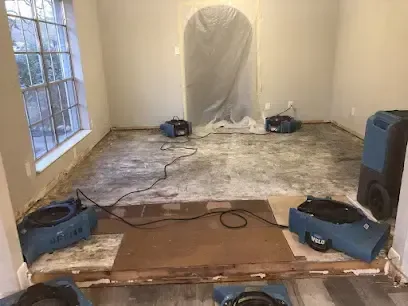
The drying team opens a sagging ceiling in a controlled way so trapped water can drain, then dries the framing, the decking and the surrounding drywall.
Air movers and dehumidifiers run until moisture readings match a dry reference. Drywall is replaced only after the framing is dry.
Older homes and the next storm
Older single story homes often have shallow attics, so there is less room for a leak to spread before it reaches the ceiling, and less room for crews to work.
A roof check before the rainy months can find loose flashing and worn spots before they cause a stain.
The process is covered under roof leak water damage for tracing and structural drying for moisture readings.
Other local services sit on the Pico Rivera hub, and the wider overview is under roof leak repairs and drying.
Questions
Why does a roof leak show up far from the actual hole?
Water runs along rafters and insulation before it drips through the ceiling, so the stain is often away from the entry point.
Is a small ceiling stain urgent?
Yes. A stain means insulation and drywall have already absorbed water, and drying early keeps the damage smaller.
Should wet attic insulation be replaced?
Wet insulation usually holds moisture and is removed, then the framing is dried.
Can a roofer and a drying team work together?
Yes. The roofer stops new water, and the drying team removes and dries what is already wet.
When is the ceiling repaired?
After the framing and drywall readings match a dry reference, so repairs do not trap moisture.